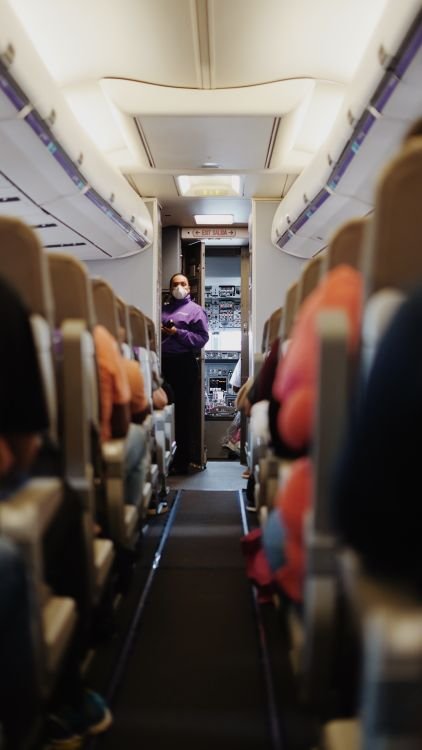
Yes — you can become cabin crew as a non-native English speaker. Airlines recruit multilingual crew deliberately, because their passengers speak dozens of languages, and a large share of the flight attendants flying today learned English as a second or third language. What most international airlines expect is conversational English at roughly CEFR B1–B2: you can understand passengers and colleagues, respond clearly, and keep communicating calmly when the cabin gets busy. You do not need a native accent, and you do not need perfect grammar. What you do need is to show that level consistently across every recruitment stage — and that is a preparation problem, which means it can be solved.
This guide covers what "good enough English" actually means, how each stage of cabin crew recruitment tests it, the mistakes that catch out non-native applicants, and a realistic 90-day plan to get ready.
What English level do airlines actually expect?
Job adverts usually say something vague like "fluent in English" — which sounds intimidating and means less than you think. In practice, most international airlines expect conversational English around CEFR B1–B2. At B1 you can handle routine interactions and explain things simply; at B2 you can deal with the unexpected, disagree politely, and hold a conversation under mild pressure. The upper end of that range is where confident candidates sit, because so much of the job is unscripted: a nervous flyer, a seating mix-up, a passenger who feels unwell mid-flight.
Two things matter more than any label on your CV. First, speaking and listening outweigh reading and writing — recruiters care far more about how you handle a role-play than whether you can write a formal essay. Second, clarity beats accent. An accent is not a problem; being hard to understand is. If you are unsure where you stand today, a free five-minute level test gives you an honest CEFR starting point. For a deeper look at the specific language skills recruiters assess, see our guide to Aviation English for cabin crew.
One more encouraging fact: your first language is an asset, not a handicap. Airlines actively want crew who can serve passengers in more than one language, so list every language you speak — prominently.
How each recruitment stage tests your English
Cabin crew recruitment usually runs through four stages, and every one of them is quietly an English test.
Stage 1: The application
Your CV, cover letter and online forms are screened before anyone speaks to you. Recruiters are not looking for literary style — they want accurate, professional written English, because crew complete reports and work with safety documentation every day. Spelling mistakes and obviously machine-translated phrases are the fastest way to be filtered out before a human ever hears your voice.
Stage 2: The video interview
Many airlines now ask for recorded answers to standard questions — "Tell us about a time you helped a difficult customer" is a classic. There is no interviewer to rescue you, so this stage tests spontaneous spoken English: can you organise an answer, speak at a steady pace, and finish your sentences without trailing off?
Stage 3: The assessment day
The assessment day is where English testing becomes explicit: a group exercise in which you solve a problem with strangers, role-plays that simulate passenger situations, and often a short written English test as well. We have a full stage-by-stage walkthrough in what happens at a cabin crew English test.
Stage 4: The final interview
The final interview is a sustained conversation: competency questions, follow-ups, and the small talk around them. It measures whether your English holds up over twenty to forty minutes — not just in rehearsed bursts. Our guide to passing an aviation English interview covers the question types and what recruiters are really listening for.
How to prepare for each stage
- Application: write your CV and cover letter in English yourself, then have a teacher or fluent friend correct them. Do not paste from a translation tool — recruiters recognise the tone instantly.
- Video interview: record yourself answering common questions on your phone, watch it back, and re-record. Focus on pace and sentence endings — nervous candidates speed up and swallow the ends of their answers.
- Assessment day: practise speaking in groups, not just alone. Contributing early in a group discussion — even with a small comment — is far easier than trying to break in late.
- Final interview: prepare short stories (a problem you solved, a complaint you handled, a time you worked in a team) and practise telling them aloud until they are flexible, not memorised.
Five mistakes non-native applicants make
- Memorising scripts word for word. Recruiters spot a recitation immediately — and one follow-up question collapses it. Learn ideas and key phrases, not paragraphs.
- Chasing a native accent. Time spent imitating an accent is better spent on clarity: word stress, sentence rhythm and pacing are what make you easy to understand.
- Neglecting listening. Half of every stage is understanding questions, instructions and teammates. Daily listening practice pays off more than most candidates expect.
- Going silent in the group exercise. Assessors cannot credit English they never hear. Quiet is too easily read as "unable", even when it is really "shy".
- Waiting for perfect English before applying. Confident, warm B2 communication beats hesitant C1 every time. If you are in range, prepare properly and apply.
Your 90-day preparation plan
If you already have a mid-level base, ninety days of consistent work is enough to move from "worried about my English" to "ready for the assessment day". Here is a plan that mirrors the recruitment stages themselves.
Days 1–30: Build the base
- Take a level test so you know your true CEFR starting point — and can measure progress against it.
- Do 20–30 minutes of English listening daily: cabin crew interviews, travel podcasts, in-flight announcement videos.
- Start building core service and safety vocabulary — our free Aviation English guide collects the essential phrases by situation.
- Speak every day, even alone: describe your day aloud in English while you cook or commute. Fluency grows from frequency.
Days 31–60: Train the stages
- Draft your CV and cover letter in English, then get them corrected by a teacher or fluent speaker.
- Record video answers to two interview questions each week; review, refine, re-record.
- Rehearse the classic role-play moves: apologising, explaining a rule politely, calming someone who is upset.
- Get regular group speaking practice — a live class, a conversation club, anywhere you must respond to other people in real time.
Days 61–90: Polish and apply
- Run full mock interviews with a teacher or practice partner, including follow-up questions you have not seen.
- Do short, timed writing practice so a written test on assessment day holds no surprises.
- Send your applications. Do not wait for "perfect" — you will keep improving while you wait to hear back.
- Keep the daily listening habit going. Consistency, not intensity, is what carries you through assessment day.
The bottom line
Being a non-native English speaker is not the obstacle it can feel like from the outside. Airlines are full of crew who once sat exactly where you are now, worrying about their English. The candidates who succeed are rarely the ones with flawless grammar — they are the ones who communicate warmly and clearly under pressure, and that is a trainable skill. If you would like structured help, our FLY ME! Aviation English programme was built for exactly this journey: live online classes that train the speaking, listening and interview skills airline recruitment actually tests.
Frequently asked questions
Can I become cabin crew if English is not my first language?
Yes. Airlines worldwide employ cabin crew from many language backgrounds and actively value multilingual candidates, because their passengers speak many languages too. What matters is demonstrating clear, confident conversational English — generally around CEFR B1–B2 — at every stage of recruitment. You do not need a native accent; you need to be easy to understand and able to keep communicating calmly under pressure.
What level of English do you need to be cabin crew?
Most international airlines expect conversational English at roughly CEFR B1–B2. In practice that means you can handle everyday interactions comfortably, deal with unexpected situations, and explain things clearly when it matters. Speaking and listening count for far more than reading and writing, because the role-plays, group tasks and interviews used in recruitment are all spoken. A free online CEFR level test will tell you where you currently stand.
How do airlines test your English during cabin crew recruitment?
English is assessed at every stage: written English in your CV and application forms, spontaneous spoken English in the video interview, group discussions and role-plays (often plus a short written test) on the assessment day, and a sustained conversation in the final interview. The most effective preparation trains each format separately — professional writing, recorded speaking, speaking in groups, and extended interview conversation.