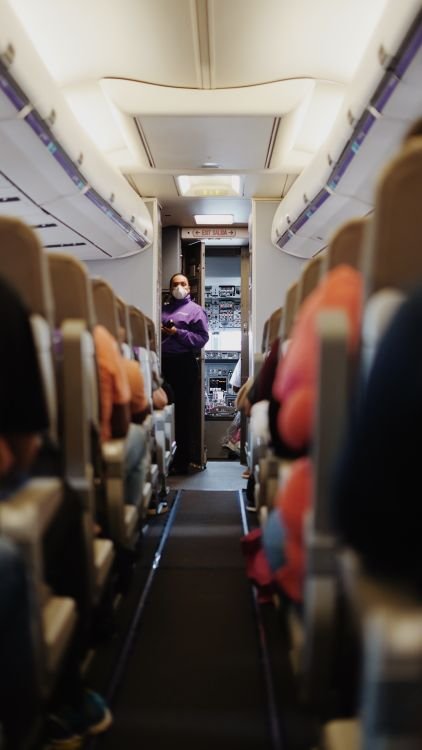
If you’ve been invited to a cabin crew assessment day, here’s the part nobody warns you about: the whole day is an English test in disguise. There’s no exam hall and no single paper marked out of a hundred, but from the moment you introduce yourself to the moment you leave, recruiters are listening to how you speak, how well you understand, and how you hold a conversation when the pressure is on. That’s what a cabin crew English test really is — not one exam, but a full day of them. Once you know what’s being assessed at each stage, the day stops feeling like a mystery and starts looking like something you can prepare for.
What a cabin crew assessment day actually looks like
Most airlines run recruitment as a single, long assessment day — you might see it called an Open Day, an Assessment Centre, or a Final Interview day. You arrive alongside dozens, sometimes hundreds, of other hopefuls, and the group gets smaller at every stage. A typical day moves through a welcome presentation, a couple of group exercises, a written English test, one or two role-plays, and, if you make the final cut, a one-to-one interview. Some airlines add a reach test — touching a marker high on a wall — and a check of grooming and height. Those parts aren’t about language. The stages that decide your fate are the ones where you open your mouth.
The written English test
Almost every major airline includes a written English test, and it’s more straightforward than most people fear. Expect grammar, vocabulary, reading comprehension, and sometimes a short piece of writing — describing a situation, or explaining how you’d handle a customer. The level sits roughly around B1 to B2 on the CEFR scale: not academic, but confident, accurate everyday English. Where candidates trip up isn’t the difficulty; it’s the clock. You’re often reading a passage and answering questions against a tight time limit, so the real skill being tested is reading quickly and accurately while your nerves are up. Practise timed reading and you take most of the sting out of this stage.
Where your spoken English is really judged
The written test is only the visible part. Your spoken English is under the microscope all day. In the group exercises — discussing a scenario, ranking items to take to a desert island, solving a problem as a team — assessors aren’t just checking whether you can speak; they’re watching whether you listen, bring quieter people in, and disagree politely. Say too little and you vanish; dominate and you look like someone passengers wouldn’t warm to. The role-plays go further: you’ll play a crew member calming an anxious passenger, handling a complaint, or working around a language barrier, and you’ll be marked on staying clear, calm and warm in English under pressure. Some airlines ask you to read a safety announcement aloud, which tests pronunciation and clarity head-on. Then comes the final interview, where competency questions — “Tell me about a time you handled a difficult customer” — test whether you can tell a clear, structured story in English rather than answer in fragments.
How to prepare for it
Preparation isn’t about memorising answers; it’s about making your English automatic so it doesn’t desert you the moment you’re nervous. Read airline safety cards and announcements aloud until they feel natural. Practise describing situations out loud — a delay, a complaint, a medical incident — in calm, complete sentences. Rehearse a few competency stories using a simple shape: the situation, what you did, the result. And get comfortable speaking in groups, because that’s the setting most candidates practise least. This is exactly the kind of role-specific English our Fly Me! aviation English programme is built around — the announcements, the customer-service language, and the assessment-day scenarios, rehearsed until they’re second nature.
Here’s the reassuring truth: the cabin crew English test rewards preparation far more than raw talent. Candidates who fail rarely lack the words — they freeze, rush, or go quiet at the wrong moment. Put in a few weeks of focused, spoken practice and you walk in sounding like someone an airline can already picture in uniform. If you’d like a structured way to get there, that’s what we do at Kensington English: real practice with native teachers, built around the situations you’ll actually face on assessment day.