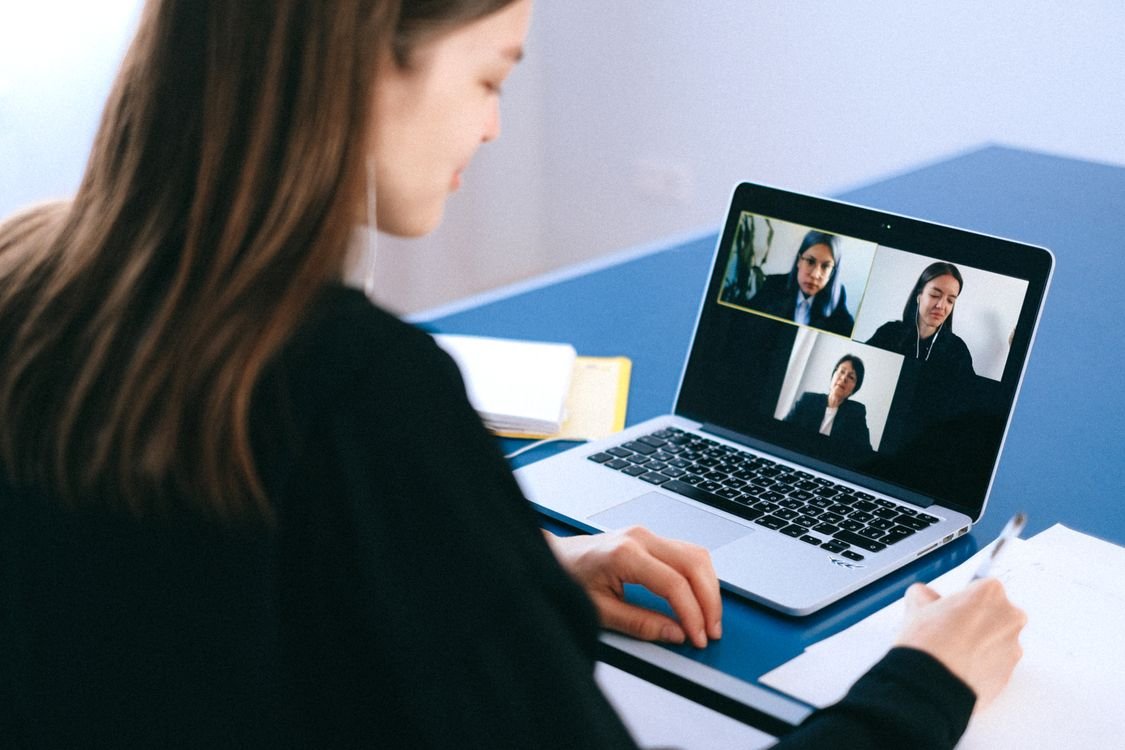
A video interview should feel easier than flying to another country to meet in person. No travel, no unfamiliar building, and you can even keep a few notes just off camera. Yet for most people preparing to work or study abroad, talking in English into a webcam feels harder than sitting across a desk would. The delay, the frozen screen, the strange experience of watching your own face while you speak — it all eats into the mental space you need for the language itself. The good news is that a video interview is one of the most predictable situations you'll ever face in English, and predictable means you can prepare for it.
Why the camera makes English harder
In a normal conversation you read the other person — their small nods, the “mm-hmm” sounds that tell you to keep going. On a video call, half of that disappears. There's often a slight audio delay, so you and the interviewer start talking at the same moment and then both apologise. You can't lean in, shake hands or point at anything. Your brain is quietly doing three jobs at once: processing English, monitoring the technology, and worrying about how you look — and the first job is the one that suffers. Once you see that the medium is stealing your attention, the fix becomes obvious. Remove as much of the other two jobs as you can before the call even starts.
Set up so English is your only job
Test everything the day before, not five minutes before. Check your camera, microphone and internet on the actual platform they'll use, because Zoom, Teams and Google Meet all behave a little differently. Sit with a window in front of you rather than behind, so your face is lit and easy to see. Close every other program so nothing pops up mid-sentence. Put a glass of water within reach — a dry mouth is the enemy of clear speech. And stick three or four anchor phrases on a note beside the camera: not a script, just reminders like “my main strength,” “a problem I solved,” “why this company.” When the technology is boring and reliable, your whole mind is free for the words.
Phrases for the moments video throws at you
Some situations only happen on camera, and knowing the English for them stops a small glitch turning into panic. If the sound breaks up, don't freeze — say “Sorry, you cut out there — could you repeat the last part?” If you need a moment to think, “That's a good question, let me think for a second” is completely normal and buys you time. If you talk over each other, a quick “Sorry, please go ahead” resets it instantly. And if you genuinely didn't follow, “Just to make sure I've understood, you're asking about…” turns confusion into a moment that actually makes you look careful and professional.
Structure every answer so you never ramble
Interviewers abroad are listening for clear, organised answers, and the simplest way to give one is to signpost. Open with a headline — “The biggest project I've led was…” — then give the detail, then finish with the result. For experience questions, the STAR shape works every time: Situation, Task, Action, Result. Say what the situation was, what you had to do, what you actually did, and how it turned out. It stops you drifting halfway through and losing your grammar in one long, tangled sentence. Short, finished sentences sound far more fluent than long ones that collapse under their own weight — and on a slightly laggy connection, they're much easier for the interviewer to follow too.
Practise on camera, not just in your head
Reading these tips won't build the skill — recording yourself will. Set up your phone or laptop exactly as you would for the real thing, pick five common questions — “Tell me about yourself,” “Why do you want this role,” “Describe a difficult situation at work” — and answer them out loud, on camera. Then watch it back. You'll hear where you stall, spot the filler words, and notice whether you're looking at your own image instead of the lens. It's uncomfortable the first time and genuinely useful by the third. It helps to be at ease with the platform itself too, so it's worth reading up on speaking English confidently on Zoom and video calls before the day.
A video interview rewards preparation far more than raw talent, and the language part is something you can rehearse until it feels routine. If you'd like a teacher to run realistic mock interviews, correct the phrases that let you down and help you sound calm on camera, take a look at the courses at Kensington English. A few focused sessions before the real call can be the difference between hoping your English holds up and knowing that it will.