Almost everyone starts learning English the same way: a burst of energy, a new app, a promise to study every night. Two weeks later, life gets in the way and the whole thing quietly collapses. If that sounds familiar, the problem was never your discipline — it was that you were relying on motivation, and motivation is a terrible employee. It shows up when things are exciting and vanishes the moment you’re tired. A routine works differently. Once it’s built, it runs on autopilot, and that’s exactly what steady progress in English requires. Here’s how to build one that survives a bad week.
Start absurdly small
The biggest mistake learners make is going too big. You decide you’ll study an hour a day, you manage it twice, and then a busy Tuesday breaks the streak and you feel like a failure. Flip it around: pick a daily amount so small it feels almost silly. Ten minutes. One podcast episode on the commute. Five new words at breakfast. The point of starting tiny isn’t the ten minutes — it’s that you show up every single day, and showing up is the habit you’re actually training. You can always do more once you’ve arrived at your desk. Most days you will. But on the hard days, ten minutes keeps the chain unbroken, and an unbroken chain is worth more than a heroic weekend you never repeat.
Anchor English to something you already do
New habits stick best when you glue them to old ones. Instead of “I’ll study English sometime today” — which never finds a time — tie it to a fixed moment that already happens automatically. “After I pour my morning coffee, I read one news article in English.” “While I’m on the train home, I do one speaking exercise.” The existing habit becomes the reminder, so you don’t have to rely on willpower or a notification you’ll swipe away. Be specific about when and where, because vague plans are the ones that evaporate. A routine with a time and a place is a routine; a routine that lives only in your good intentions is a wish.
Mix the four skills, not just the easy one
Left to our own devices, we practise what we enjoy and avoid what we find hard. If you love watching series in English but freeze when you have to speak, guess which skill is falling behind. A routine that sticks is also a routine that’s balanced. Across a week, try to touch all four skills: reading and listening you can fold into daily life, while speaking and writing usually need a deliberate slot. You don’t need to do everything every day — listen on Monday, speak on Wednesday, write a few sentences on Friday. Rotating keeps things fresh and stops the lopsided progress that leaves you fluent on the sofa but tongue-tied in a real conversation.
Track it where you can see it
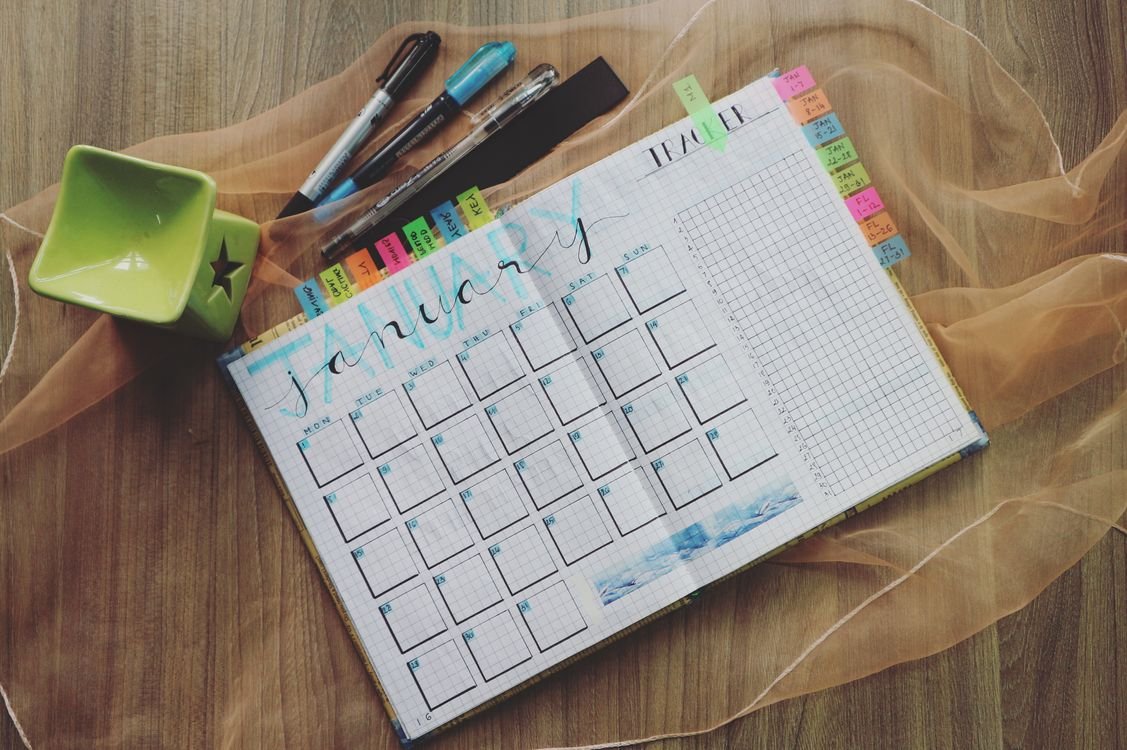
There’s a reason the planner in the photo has a habit tracker. Marking a box after each session sounds trivial, but watching a row of ticks build up is genuinely motivating — you don’t want to break the run. Use whatever you’ll actually look at: a paper calendar on the wall, a note on your phone, a simple tick chart. The goal isn’t perfection. Miss a day and you’ve missed a day; the only rule that matters is never missing twice in a row. One skip is a blip. Two skips is how a routine dies, so treat getting back on the next day as the real discipline.
Build in a reason to keep going
Routines need fuel, and the best fuel is a deadline or a person you’re accountable to. A booked exam, a trip abroad, a job you want — a real goal turns “I should study” into “I need to study,” and that changes everything. Accountability helps just as much: a study partner, a teacher expecting you on Thursday, a class you’ve paid for. It’s far easier to skip a session that only you know about than one where someone’s waiting. This is quietly why regular classes work so well — the fixed weekly slot builds the backbone of a routine for you, and the rest slots in around it.
Don’t wait to feel ready or motivated — you’ll be waiting a long time. Pick one tiny action, anchor it to something you already do today, and let the routine carry you when motivation doesn’t. If you’d like a fixed weekly anchor to build everything else around, the live online courses at Kensington English give you a regular class, a teacher who expects you, and a clear path to work towards. Start small this week, and let consistency do the heavy lifting.