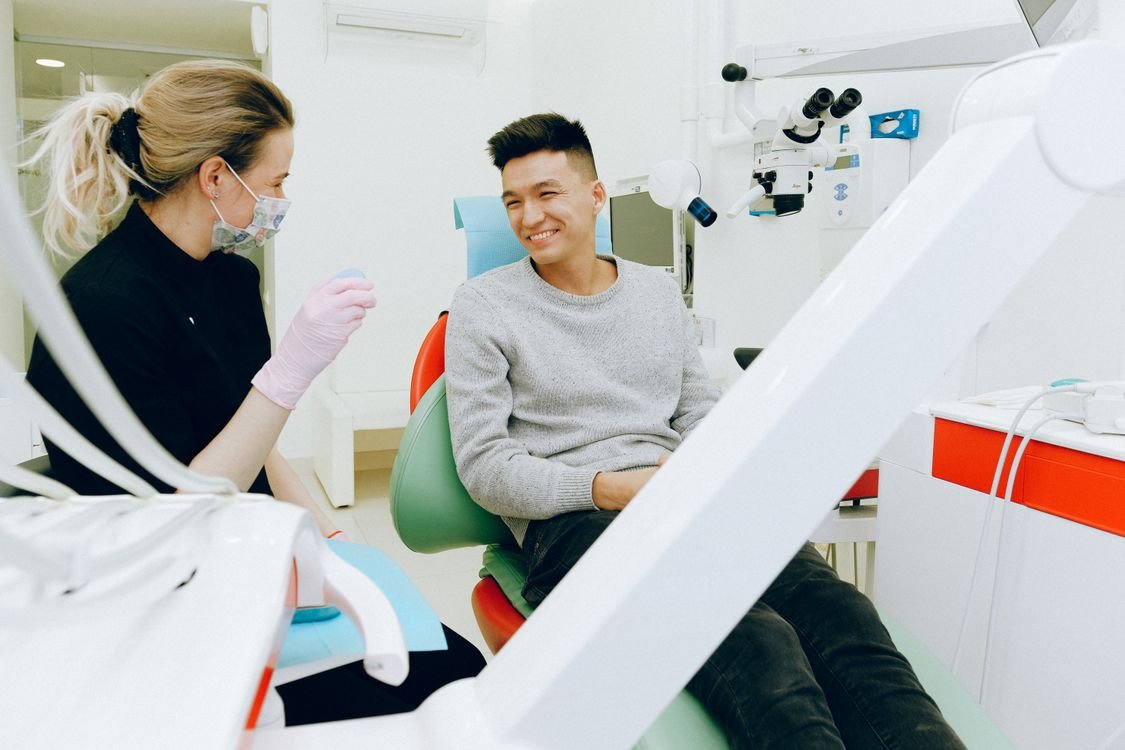
A good dentist is doing two jobs at once: the clinical work in the mouth, and a near-constant conversation with the person it belongs to. You’re explaining what you’re about to do, reading whether someone is anxious, talking a nervous patient through an injection, and handing over to a nurse or hygienist without breaking your rhythm. When English isn’t your first language, that second job gets harder exactly when the first one needs all your concentration — and for internationally trained dentists moving to the UK, it’s often the English, not the dentistry, that feels like the real obstacle. Here’s the English that actually matters chairside, and how to build it.
Why dental English is its own skill
Clinical vocabulary is the easy part — you already know what a crown, a cavity and an extraction are. The hard part is everything around it: the reassuring, plain-language version you use with a frightened patient, the precise instructions you give a nurse mid-procedure, and the careful wording that explains a treatment plan and its cost without alarming anyone. You’re constantly translating between registers — technical with colleagues, warm and simple with patients — sometimes in the same minute. Put that on top of working with your hands while you talk, and small gaps in fluency that wouldn’t matter in a meeting suddenly do. That’s why general English lessons rarely prepare dentists fully: the words are specialised, but it’s the delivery and the constant switching that take real practice.
Putting patients at ease in the chair
Most patients arrive a little nervous, and the words you choose set the tone. Simple signposting phrases do a lot of work: “You might feel a little pressure, but it shouldn’t hurt”, “I’m just going to have a look first — you don’t need to do anything”, “If you’re uncomfortable at any point, just raise your left hand.” Explaining a diagnosis is its own skill: “You’ve got some decay on this tooth, and if we leave it, it’ll get worse” is clearer and kinder than the textbook version. Talking about cost needs tact too — “This isn’t covered on the NHS, so let me talk you through the private options” — because money conversations go wrong fast when the English is clumsy. And consent only counts if the patient genuinely understands you, so plain, confident phrasing isn’t just good manners; it’s part of treating people safely.
Running the team: nurses, hygienists and handovers
A dental surgery runs on quick, unambiguous communication, usually while everyone’s hands are full. You need to ask for instruments and materials clearly, direct your nurse without sounding brusque, and hand over to a hygienist or another clinician so nothing gets lost. “Can I have the mirror and probe, please”, “We’ll need composite for this one”, “Could you suction just here” — short, polite, specific. Writing matters as much as speaking: clinical notes have to be accurate and complete, referral letters to specialists or a patient’s GP need the right professional tone, and treatment plans must be legible to whoever reads them next. This is where one-to-one practice earns its place — rehearsing the exact phrases of your working day with a teacher, as in focused one-to-one English lessons, builds confidence far faster than a general class that never goes near a dental chair.
Registration, exams and professional English
For dentists qualifying to practise in the UK, English is a formal part of the route. The General Dental Council asks for evidence of English competence — usually IELTS or the OET — and the Overseas Registration Exam tests whether you can communicate with patients and colleagues, not just whether you know the dentistry. Examiners watch how you take a history, explain a procedure and respond to a worried patient, all in English and under time pressure. Preparing for that is less about grammar drills and more about rehearsing real situations out loud until they’re automatic: taking a history, breaking slightly unwelcome news gently, calming an anxious patient, justifying a treatment choice.
None of this is about sounding like a native speaker — it’s about your English getting out of the way, so your patients trust you and your team understands you first time, every time. If you’d like to build the exact English your work demands, from chairside reassurance to exam-day scenarios, take a look at our courses and we’ll match you with a teacher who can train it around your real cases.