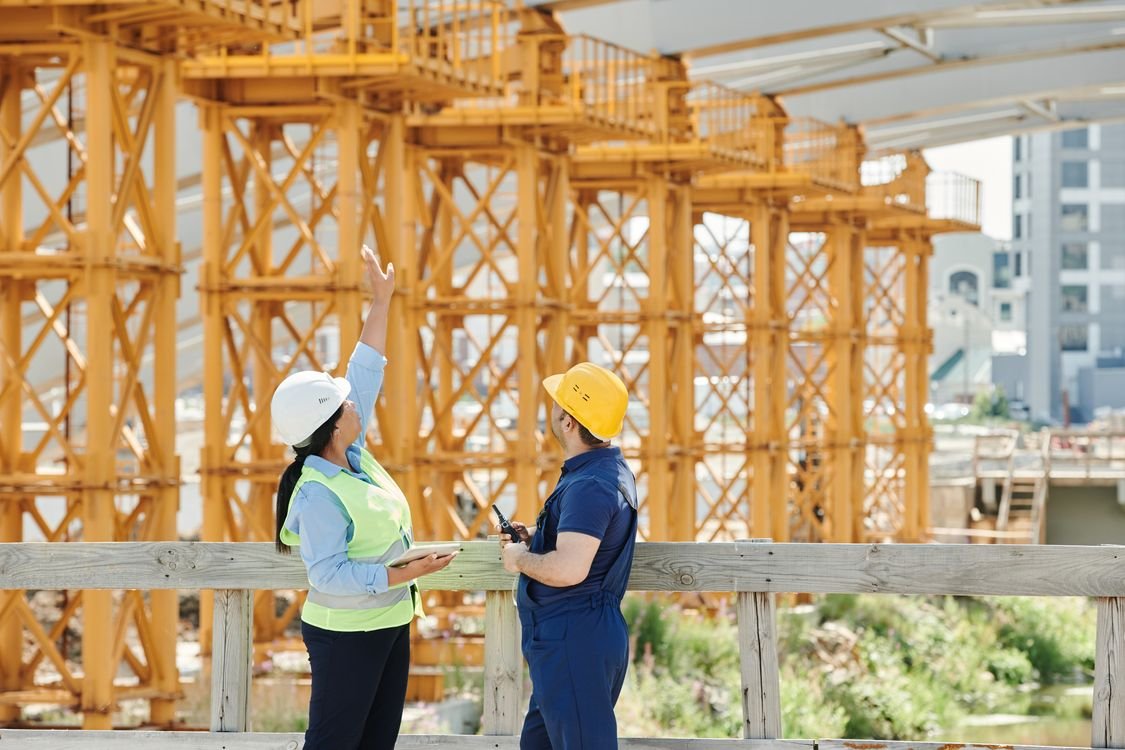
On a building site, a misheard instruction isn’t just an awkward moment — it can mean a wrong cut, a dropped load, or someone standing exactly where the excavator is about to swing. Modern construction runs on people from all over the world working shoulder to shoulder, and the thing holding it together is English: the morning briefing, the shout across the scaffold, the sign-off on a permit. When a crew’s English is patchy, the work slows down and the risk climbs. English for construction and site teams has almost nothing to do with polished grammar. It’s about giving an instruction that lands the first time, understanding a safety warning without hesitating, and being able to stop the job and say so when something looks wrong.
Why site English is a safety issue, not a nicety
On most jobs the biggest hazard isn’t the plant or the height — it’s a message that doesn’t get through. A banksman’s directions, a warning shouted over a compressor, a last-minute change to the lifting plan: these all have to be understood instantly and correctly, often in noise, often through a hard hat and a mask. Get the words wrong and the consequences are immediate. That’s why site English needs to be trained as a safety skill, not a “nice to have.” Workers need to follow a spoken warning, read a hazard sign, and — just as important — feel confident enough to ask “Can you say that again?” rather than nodding along and guessing. On a site, guessing is dangerous. This is exactly the kind of real-world, job-specific communication our Workplace English course is built around.
The English a working day on site runs on
Beyond safety, an ordinary day is full of small exchanges that have to be precise. Instructions need to be short and sequenced: “Move the pallet to the second bay, then chase up the delivery.” Measurements and quantities can’t be fudged — the gap between “fifteen” and “fifty,” or a drawing read the wrong way round, is a day’s work lost. Then there’s the trade vocabulary itself: first fix and second fix, formwork, rebar, screed, snagging, and the names of tools and materials a merchant or a foreman will expect you to know. Add directions and locations (“by the hoist,” “level three, east side”), phone and radio calls where you can’t fall back on gestures, and the daily back-and-forth with suppliers, and it’s clear how much of the job travels through language that most English training never touches.
Toolbox talks, inductions and the paperwork
Every site starts with an induction, and it’s usually delivered fast, in English, with a form to sign at the end. Toolbox talks work the same way: a short safety briefing you’re expected to follow and act on. Permits to work, RAMS (risk assessments and method statements), near-miss reports and hazard reporting all carry their own set phrases, and signing to say you understood something you didn’t is a genuine risk — to you and to everyone around you. Being able to follow a briefing, ask a question when a step isn’t clear, and report a problem in plain, confident English is part of doing the job properly. Supervisors and gangers need even more of it, because they’re the ones passing instructions down the line and escalating problems back up.
How to build the English your site needs
You won’t get there with a generic grammar app. Build it from the work itself. Keep a running phrase bank of the site language you use most — the induction, the toolbox talk, the “stop, that’s not safe” moment — and rehearse those exact situations until they’re automatic. Role-play a briefing with a colleague. Learn the trade vocabulary in groups that make sense (everything to do with concrete, everything to do with lifting) rather than as random word lists. Above all, practise with someone who can pitch the language to your level and give honest feedback, because drilling the wrong phrase confidently just makes it harder to fix later. A structured course that uses real site scenarios will move you far faster than studying English in the abstract, because it trains the precise register a site actually runs on.
Construction is one of the most international industries there is, and a huge amount of what keeps it safe and moving travels through English — in the briefing, the warning, the quick word before a lift. Getting that English right isn’t about sounding impressive; it’s about being understood clearly and quickly by the people working alongside you, exactly when it matters most. If you’d like to build that clarity and confidence with teachers who understand the workplace, take a look at the options on our courses page. Strong site English is quiet, exact and dependable — which is precisely why it’s worth training properly.