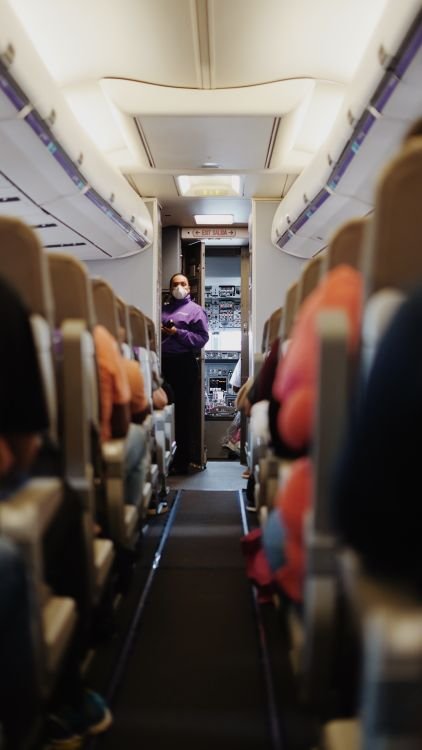
A passenger is standing in the aisle, voice rising, and the whole cabin has gone quiet to watch. Their bag won't fit, the flight is delayed, the meal they wanted has run out — the reason barely matters. What matters is that thirty pairs of eyes are on you, and the only tool you've got is the language coming out of your mouth. Cabin crew are hired for their composure, but composure without the right English is just a calm face over a stuck brain. The good news is that handling difficult passengers is far more about a handful of learnable phrases and a steady tone than it is about being born unflappable.
Lower the temperature before you solve the problem
The instinct is to jump straight to the fix — explain the policy, quote the rule, prove you're right. Don't. An upset passenger can't really hear a solution until they feel heard, so your first job is emotional, not logical. Start by naming the feeling: “I can see this is really frustrating, and I'm sorry you've had this experience.” Notice that you haven't admitted the airline did anything wrong — you've simply recognised that a human being is upset, which is always true and always safe to say. Then keep your voice half a step slower and quieter than theirs. People unconsciously mirror the energy in front of them, and a calm, even tone brings the volume down faster than any clever sentence ever could.
Acknowledge without admitting fault
This is the tightrope every crew member walks, and the right English keeps you steady on it. You want to sound warm and sorry without accepting blame that isn't yours to give. Lines like “I completely understand why you'd feel that way” and “thank you for your patience while I sort this out” do exactly that: they're kind, they're professional, and they commit the airline to nothing. Steer well clear of “that's not my job” or “there's nothing I can do” — both pour petrol on the fire. Even when you genuinely can't fix something, there's a softer version: “I'm not able to change your seat right now, but here's what I can do.” That little word but quietly turns a dead end into a next step.
Say no without saying no
Half of all difficult moments are really just refusals in disguise, and experienced crew almost never reach for the bare word “no.” They offer an alternative instead. A passenger wants a third glass of wine you shouldn't serve? “Let me bring you some water for now, and we'll see a little later.” Someone demands to move into an empty seat in a premium cabin? “Those seats are reserved, I'm afraid, but let me find you a bit more room back here.” The structure never changes: a short reason, then an offer. It respects the passenger, protects the rule, and — crucially — gives them something to say yes to, which is how you end a conversation rather than prolong it.
Stay professional when it gets personal
Sometimes a passenger crosses the line. They raise their voice, they turn rude, they make it about you. This is precisely when your English should become more formal, not less — formality is armour. Move to full, courteous sentences and a little polite distance: “I understand you're upset, sir, and I do want to help. I'll need you to lower your voice so we can sort this out together.” Short, clear, calm. If it keeps climbing, set a boundary the same measured way: “I'm going to step away for a moment and come back to this.” Never trade insults, never reach for sarcasm, and never let your pitch rise to meet theirs — the moment it does, you've handed them the upper hand and lost the rest of the cabin. And if safety is ever genuinely in question, that stops being a language problem: you involve the senior crew and, if needed, the flight deck.
Rehearse the words before you need them
Here's the part most people miss: you can't invent this language in the moment. When your heart rate is up, your brain grabs whatever phrases are already worn smooth by practice — and if those phrases are clumsy or half-remembered, that's what falls out of your mouth. The crew who stay graceful under pressure have said these exact sentences hundreds of times, very often in a second language, until they're automatic. That's entirely learnable, and it's wonderfully specific: the acknowledgement lines, the soft refusals, the boundary scripts. Say them aloud, role-play the awkward scenarios with a partner, and get honest feedback on your tone as much as your words.
Difficult passengers will always be part of the job — but freezing, fumbling, or letting a moment spiral doesn't have to be. With the right phrases ready and a tone you can hold steady, most tense situations settle in under a minute. If you're building a cabin crew career and want to practise exactly this kind of real-world aviation English, our Aviation English courses at Kensington English are built around the situations you'll genuinely meet on board — not textbook dialogues you'll never use.